
For most of the past decade, choosing a crypto data API had a default answer. You signed up for CoinGecko, plugged in prices, and moved on.
That default is starting to look legacy. Modern crypto apps need more than a price feed. They need wallet balances, transaction histories, DeFi positions, and token security checks. A newer generation of providers ships all of that under one key, and the pricing math has shifted with it.
We spend a lot of time on the data side of crypto. Earlier this year we mapped the wider field in our top crypto data API providers guide. Since it went live, one head-to-head question has come up more than any other: CoinGecko API or CoinStats API?
So we sat down and worked through both, endpoint by endpoint. This review covers what each API returns, where the pricing gap sits, and which one fits your build.
One note on scope before we start. CEX.IO Trading API covers a different layer: exchange trading and account automation. The two APIs below cover the data layer, meaning market, wallet, and portfolio data read from public sources. Many production stacks use both.
The Short Answer
CoinGecko API is the legacy pick. It defined the market data category, and it still serves that narrower job. CoinStats API is the excellent all-in-one successor. It matches that same market data core, then adds the entire portfolio layer, at roughly 7x lower cost per call at entry tiers.
That last sentence is why this comparison exists. For years, adding wallet balances, transactions, or DeFi positions to an app meant stitching together three or four separate providers on top of a price feed. CoinStats API collapsed that stack into a single key. Whether that qualifies as “changing everything” depends on what you build, so let’s look at the evidence.
How We Ran This Review
“Expert review” gets thrown around, so here is what sits behind this one.
Documented capabilities first. Every feature claim in this article traces to the official documentation of CoinGecko API and CoinStats API as of August 2026. Where a capability is partial or gated, we say so, including which plan unlocks it.
Live pricing, reconciled. We pulled both pricing pages the week of writing and computed effective cost per 1,000 calls from the entry commercial tiers. The per-call figures in this review divide out from the published plans, and every number is date-stamped.
Seven scoring criteria. We scored both platforms on market data depth, exchange reference breadth, wallet and portfolio data, DeFi position resolution, token security, AI and MCP tooling, and cost efficiency. The radar chart below reflects those scores.
Independent cross-checks. We compared our conclusions against third-party comparisons from CoinAPI, Apidog, and developer community roundups, plus our own three prior reviews of the category. Where the verdicts differ, we flag it. Here, they don’t.
One honest limitation: this is a capability and pricing review, not a synthetic load test. We did not benchmark latency or uptime, and both providers publish their own SLAs. For architecture decisions at scale, run your own workload against both free tiers. That’s what they are for.
Two APIs, Two Philosophies
The cleanest way to frame this comparison is by what each API is trying to describe.
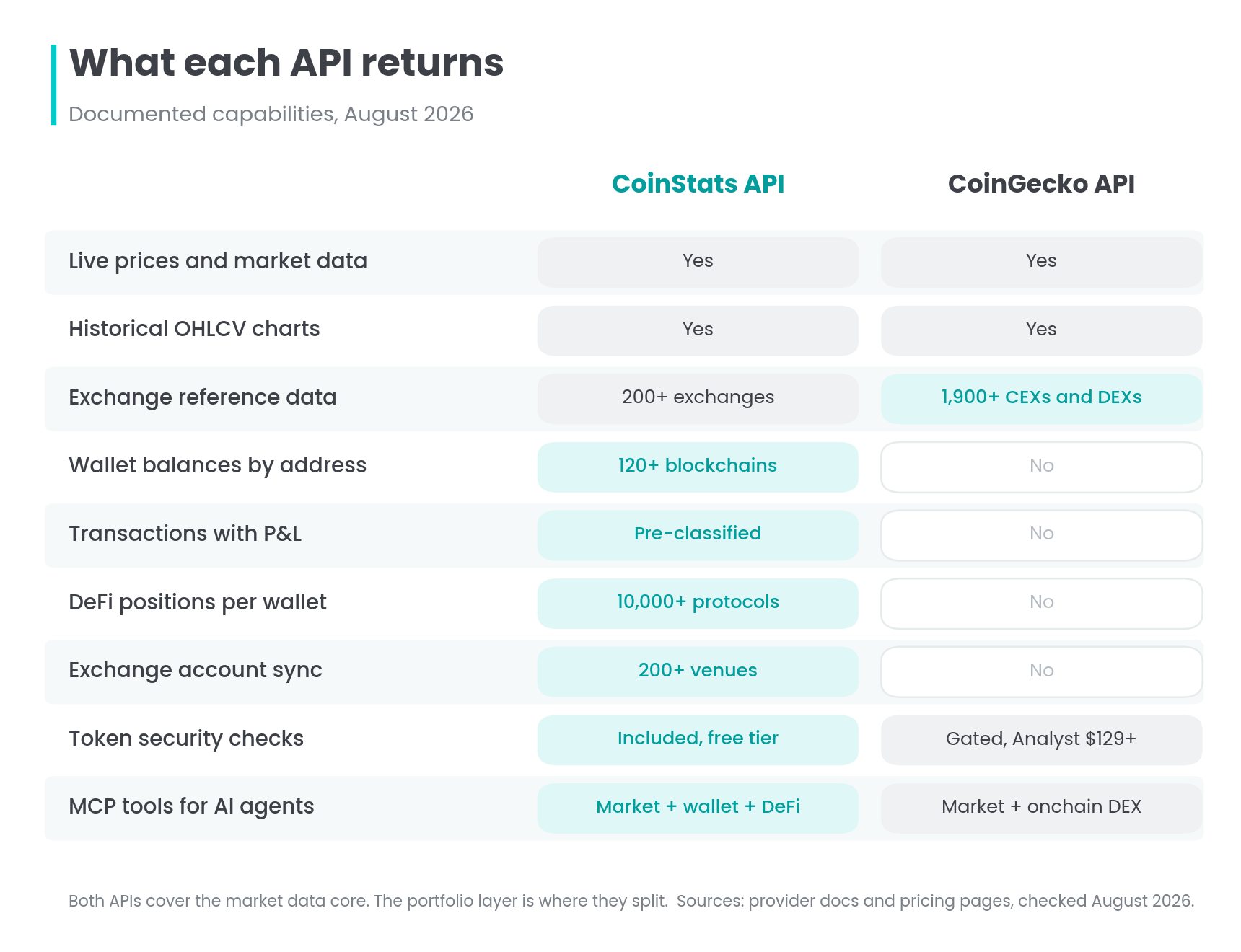
CoinGecko API describes the market. Prices, market caps, token metadata, exchange tickers, DEX pairs, trending assets. If a question is about an asset or a venue, CoinGecko probably has an endpoint for it.
CoinStats API describes the user’s crypto. It covers the same market data, then keeps going: what a wallet holds, what it earned or lost, where it’s staked, which exchanges it trades on, and whether a token in it looks risky.
That difference sounds subtle. In an architecture diagram, it’s enormous. A market data API answers “what is ETH worth?” A portfolio-layer API also answers “what is this address worth, and how did it get there?”
Here is what that means in practice. To show a user’s wallet on a market data API, you source token balances from a separate onchain provider, pull prices for each token, then join and value the result yourself. Every chain adds parsing work, and every DeFi protocol adds more. On CoinStats API, that entire pipeline is one call: address in, priced holdings out. Multiply that by transactions, P&L, and DeFi positions, and the integration gap becomes months of engineering.
CoinGecko API: The Legacy Option
CoinGecko is the incumbent. It has operated as an independent data source since 2014, and its aggregation methodology became the default reference price for wallets, explorers, and exchanges.
The coverage numbers are the widest in the category. CoinGecko’s own API page cites 18,000+ listed coins, 1,900+ exchanges across CEXs and DEXs, and 43 million+ onchain tokens on 250+ networks through its GeckoTerminal feeds. The developer stack has modernized too: REST, WebSocket streaming, webhooks, and an AI toolkit with an MCP server, a CLI, and x402 endpoints for market and onchain DEX data.
The limits show up past market data. There is no wallet balance lookup for an arbitrary address. No per-wallet transaction history or profit and loss. No DeFi position resolution. Token security exists on its onchain endpoints as legitimacy metrics, mint and freeze authority checks, and a GeckoTerminal score. The deeper security data sits behind the Analyst plan at $129 per month. If your product needs to understand what a user owns, you bring that data from somewhere else.
Best for: token discovery, exchange reference data, market dashboards, and any product where an independent price source is the whole job.
CoinStats API: The New Standard
CoinStats API is the most complete crypto data API we have reviewed this year. It starts from the same market data core. Coverage spans 100,000+ coins, 200+ exchanges (CEX.IO, Binance, Coinbase, and Hyperliquid included), and 120+ blockchains. The same infrastructure powers the CoinStats app and its 1M+ monthly users, so the data layer is production-tested at consumer scale.
The portfolio layer is where it separates. Pass a wallet address and structured JSON comes back: token balances across 70+ EVM chains, Solana, and Bitcoin, with xpub, ypub, and zpub support for HD wallets. Transactions arrive pre-classified with USD values and per-trade profit or loss. DeFi positions resolve automatically across 10,000+ protocols, so staking, lending, and LP exposure surface per wallet without custom parsing. Exchange account sync covers 200+ venues, and a Token Risks endpoint flags honeypots and contract risks on the free tier. We went deeper on this layer in our best crypto wallet API guide, where the same capabilities put CoinStats at the top of the list.
In a simple way: CoinStats API ≈ CoinGecko API + wallets + DeFi + portfolio analytics + token security
The developer experience holds up across chains. One schema covers everything, so a Solana address, a Bitcoin xpub, and an EVM wallet aggregate into a single portfolio view without format juggling. The same API key works for REST and MCP, and the free tier is enough to prototype a real feature before paying.
The AI angle deserves its own mention. CoinStats ships an MCP Server with 20+ tools that expose wallet, DeFi, and portfolio data to AI agents. Claude, Cursor, and similar assistants can query “what does this wallet hold?” with no custom glue code. CoinGecko’s MCP covers market and DEX data well, but it cannot answer wallet-level questions, because the underlying API doesn’t have them.
Best for: portfolio trackers, tax and accounting tools, multi-chain wallet apps, AI crypto assistants, and teams that want one key instead of four providers.
Head-to-Head Scores
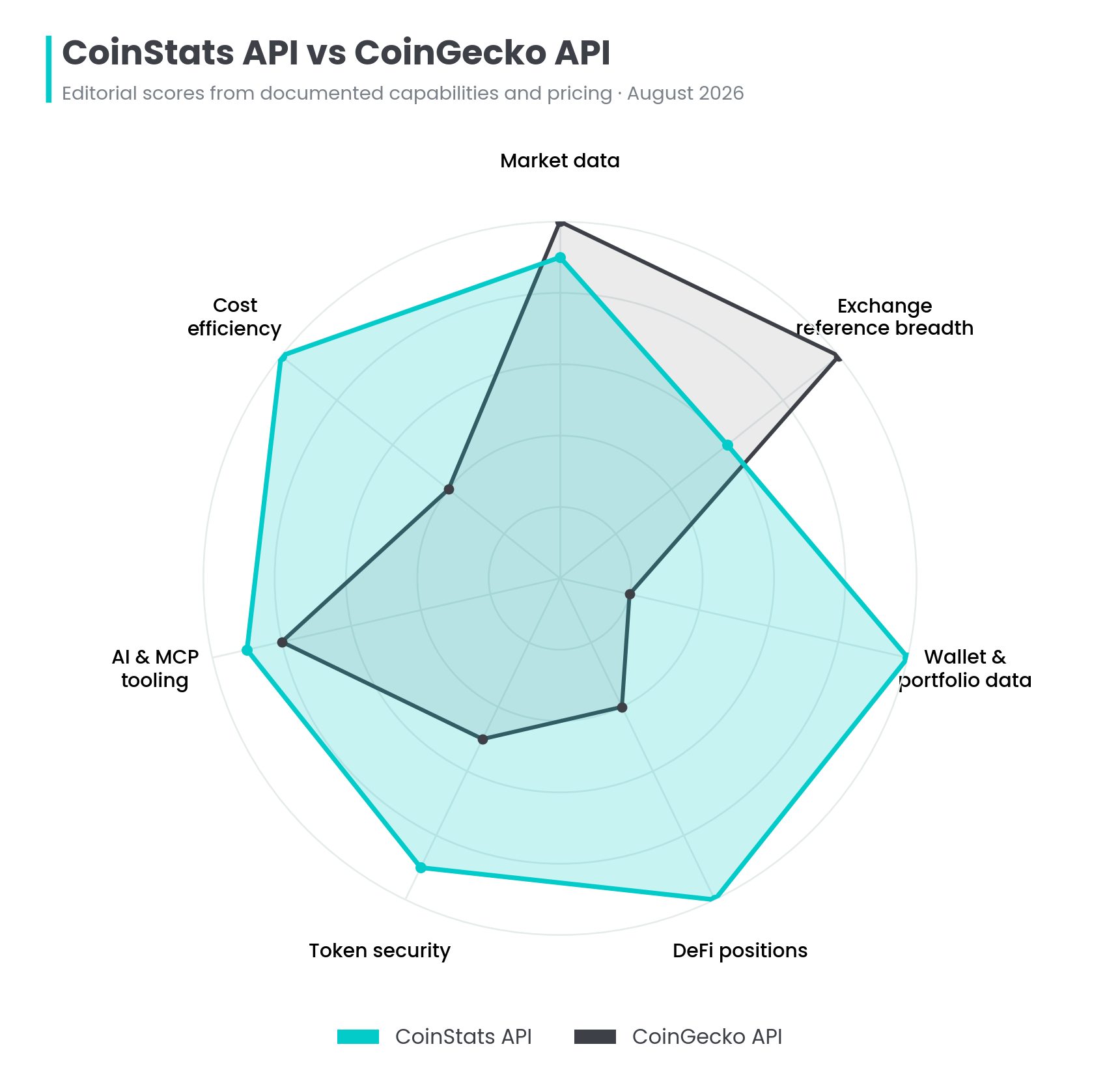
We scored both APIs across seven criteria, based on documented capabilities and current pricing.
The shape of the chart tells the story. CoinGecko API wins the two axes it was built for: raw market data depth and exchange reference breadth. Its 1,900+ exchange catalog, counting CEXs and DEXs, is still the widest reference list in the category.
CoinStats API takes the other five. Wallet and portfolio data is not close, because CoinGecko doesn’t compete there. DeFi positions, token security, and cost efficiency follow the same pattern. AI tooling is the tightest race: both ship MCP servers, but CoinStats’ wallet-aware tools give agents more to work with. Add it up and CoinStats API is the strongest all-round crypto data API of 2026.
Pricing: Where the Gap Gets Wide
Both platforms use credit-based tiers, and both publish transparent pricing. The entry math, checked in August 2026, looks like this.
CoinGecko API’s Basic plan costs $35 per month for 100,000 calls, with a commercial license included. That works out to about $0.35 per 1,000 calls. Overage runs $250 per additional 500,000 calls.
CoinStats API’s Starter plan costs $49 per month for 1,000,000 credits at 30 requests per second. That works out to about $0.05 per 1,000 calls.
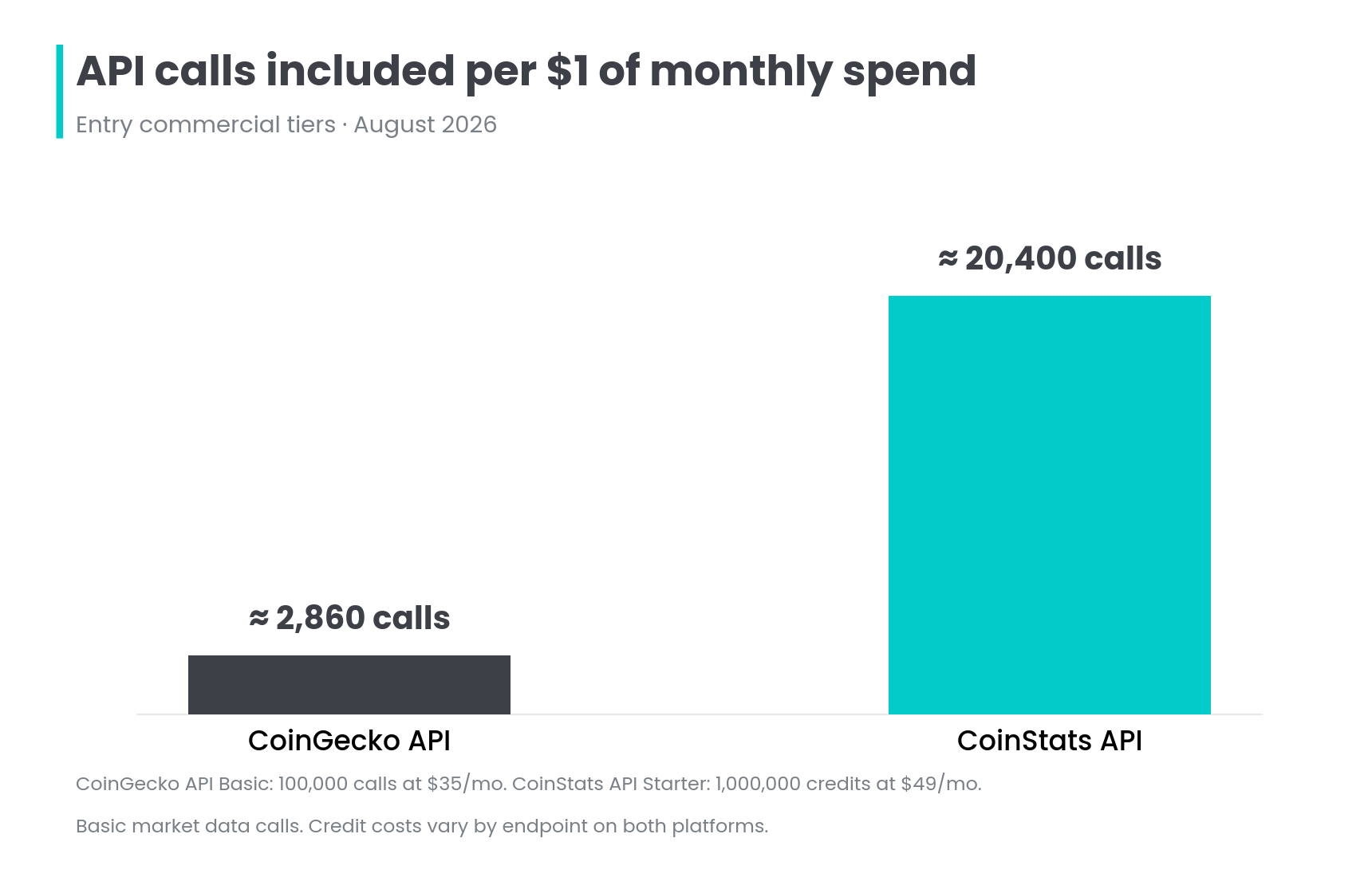
Same math, different angle: for every dollar of monthly spend at entry tier, CoinGecko API includes about 2,860 calls. CoinStats API includes about 20,400.
A concrete scenario makes it sharper. An app making 500,000 calls a month needs CoinGecko API’s Analyst plan at $129. On CoinStats API, the $49 Starter plan covers that volume twice over, with room left for wallet and DeFi calls. The gap compounds as products grow, which is exactly when switching providers hurts most.
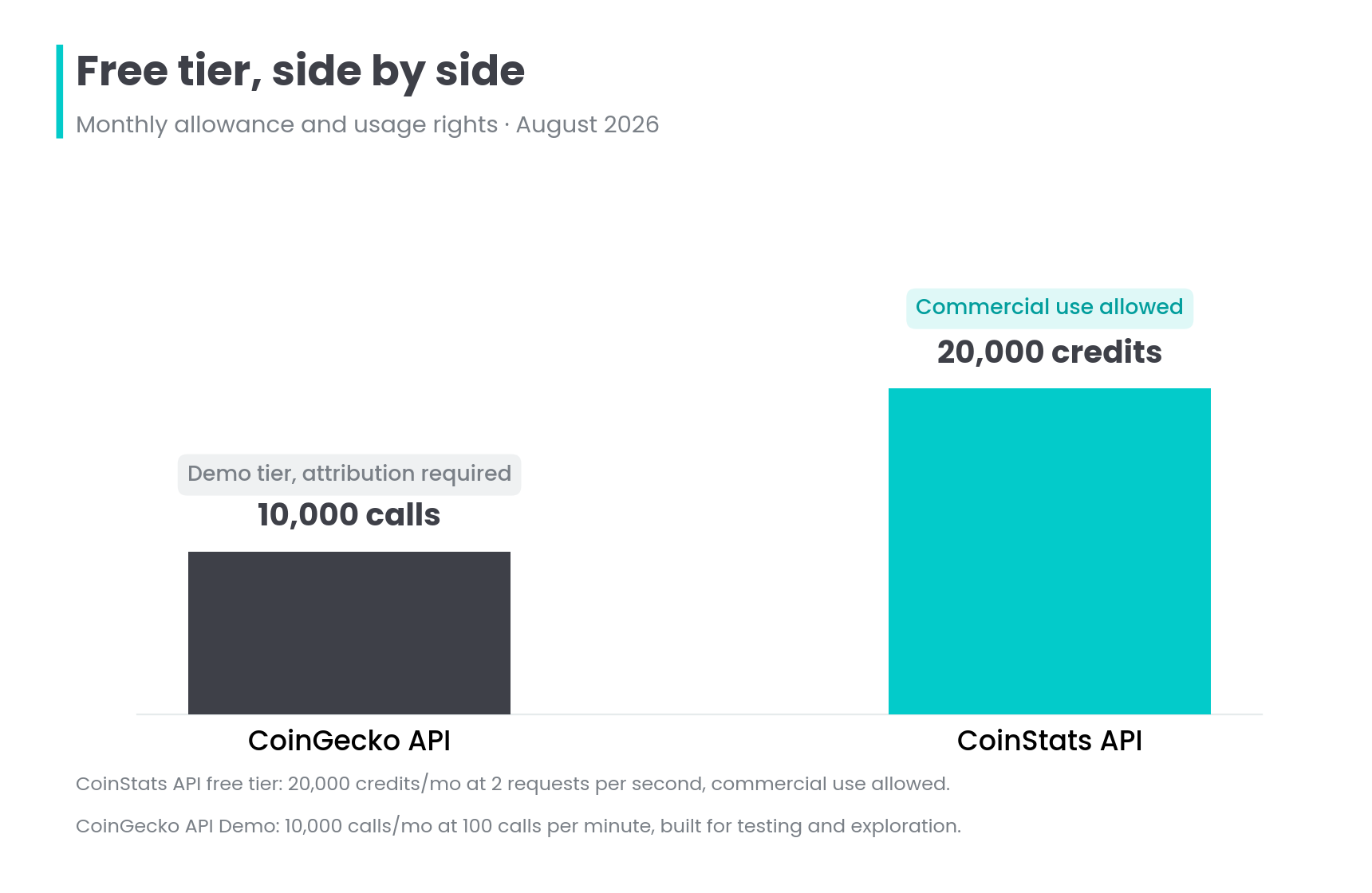
The free tiers split on usage rights rather than just volume. CoinGecko’s Demo tier offers 10,000 calls per month and is built for testing, with attribution required. CoinStats’ free tier offers 20,000 credits per month at 2 requests per second, with commercial use allowed. For a small production app, that difference matters more than the raw numbers. It means a side project can go live on CoinStats API without a card on file, and only start paying when real traffic shows up.
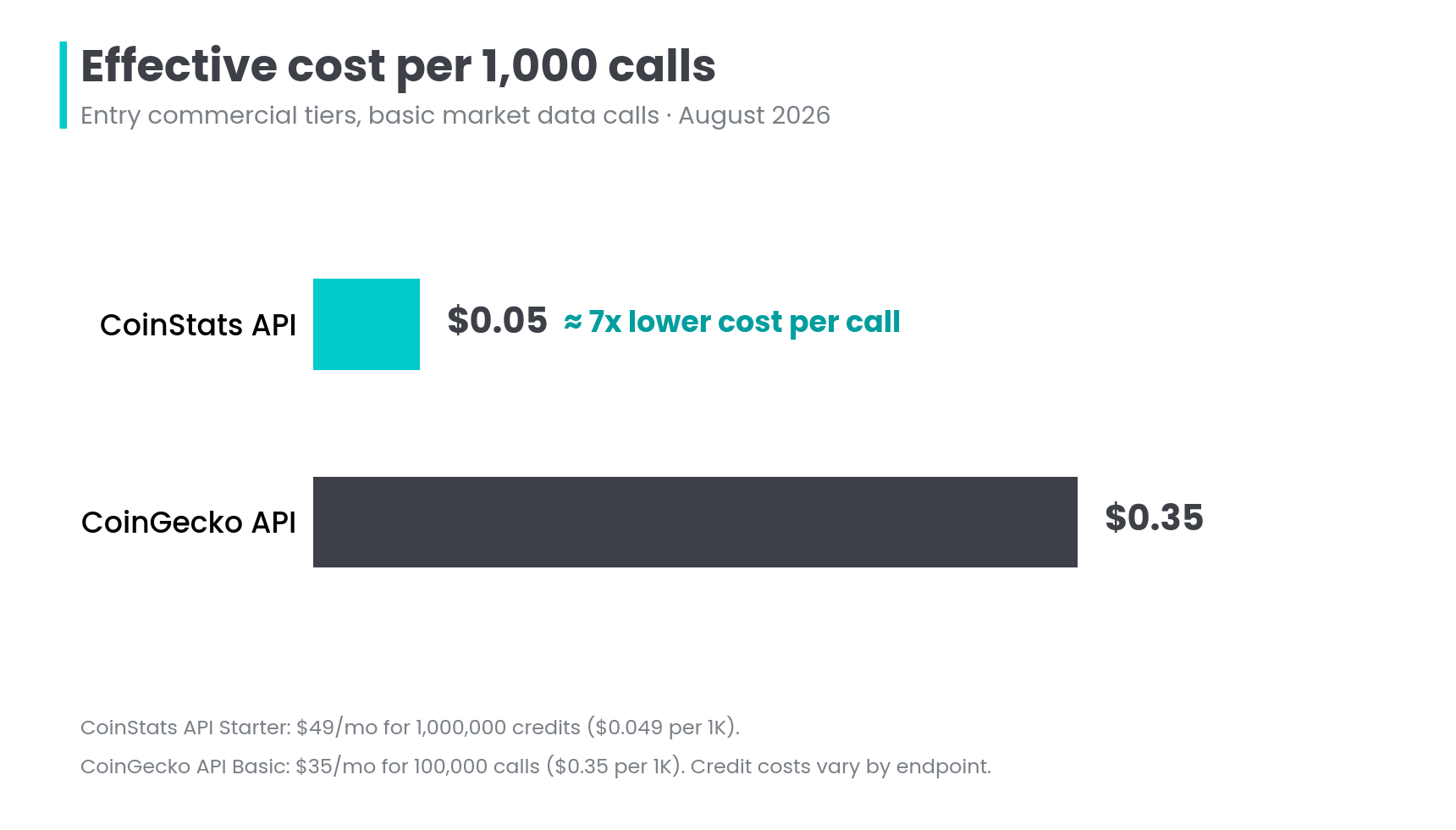
Two fairness notes on the price claim. First, this is a per-call benchmark on basic market data. Both platforms price credits by endpoint, so wallet and DeFi calls cost more than simple price lookups. Second, CoinGecko’s $35 entry point is genuinely low for a commercial license in this category. That license carries a condition, though: per CoinGecko’s plan terms, commercial products through the Pro tier must display “Data provided by CoinGecko” with a link back. The gap is not the sticker price. It’s what each dollar buys once your app scales.
What Other Reviews Conclude
We are not the only ones who ran this comparison, and the independent verdicts line up.
CoinAPI, itself a market data provider with no portfolio product to sell, published its own CoinGecko vs CoinStats API comparison and picked CoinStats API as the winner for app-layer crypto data, while noting CoinGecko’s edge in raw exchange and token discovery breadth.
Developer-tooling blog Apidog reached a similar split in its three-way CoinStats vs CoinMarketCap vs CoinGecko API breakdown, and community roundups like this best crypto APIs for developers list on dev.to place CoinStats API at the front of the 2026 shortlist.
The pattern holds chain by chain, too. When we reviewed the top 5 Solana APIs for developers, the same consolidation logic put CoinStats first for wallet, DeFi, and pricing data on a single chain.
That level of agreement is rare in crypto tooling. Vendors usually pick themselves. When a market data company, a developer tools blog, and independent community lists all land on the same name, the verdict stops reading like marketing.
Which One Should You Pick?
Match the API to what your product needs to describe.
- A market data feed for prices, charts, and history: CoinStats API. It matches the legacy core at a fraction of the cost per call.
- A portfolio tracker, tax tool, or wallet app: CoinStats API. One key covers balances, transactions, P&L, and DeFi positions.
- An AI agent or LLM-powered product: CoinStats API. Its MCP Server exposes wallet and portfolio tools, not just market data.
- Token safety checks before users trade: CoinStats API. Risk reports run on the free tier instead of a $129 plan.
- A tight budget or a commercial free tier: CoinStats API. About 7x more calls per dollar at entry, and its free tier allows commercial use.
- Deep exchange reference data and token discovery: CoinGecko API. Its 1,900+ exchange catalog is the widest in the category.
Plenty of serious stacks still run both: CoinStats API as the primary data layer, with CoinGecko API adding token discovery breadth.
The Verdict
“Changing everything” is a strong claim, so here is what it refers to. CoinGecko API didn’t get worse. It still does the job it was designed for. That job was defined in an earlier era of crypto development.
What changed is the shape of the job. Crypto apps in 2026 are portfolio-shaped, wallet-shaped, and increasingly agent-shaped. CoinStats API is the first mainstream provider to cover that whole shape under one key, at a per-call cost roughly 7x below the incumbent. The multi-provider data stack that used to be mandatory is now a choice. That is what an excellent crypto API looks like in 2026.
Even if prices are all your product needs, CoinStats API now does that job for less. If your product needs to understand what a user owns, it is the only one of the two that can. Either way, start with CoinStats API and add specialists later.
And when your app moves from reading the market to trading on it, that’s the layer we cover. CEX.IO Trading API handles exchange trading and account automation, with deep liquidity behind it. Reading the data is half the stack. Executing on it is the other half.
FAQ
Is CoinStats API better than CoinGecko API?
For most builds, yes. Both cover market data, and CoinStats API delivers it at roughly 7x lower cost per call. It then adds wallet, DeFi, and portfolio data in the same key. CoinGecko API keeps an edge on exchange reference breadth.
Is CoinGecko API still free?
Yes. The Demo tier offers about 10,000 calls a month with attribution required, and it is built for testing. CoinStats API’s free tier offers 20,000 credits a month and allows commercial use.
Can CoinStats API replace CoinGecko API?
For most apps, yes. It covers the same market data core, then adds the portfolio layer. Teams that need CoinGecko’s 1,900+ exchange reference catalog are the main exception.
What is the difference between a crypto data API and an exchange API?
A crypto data API reads public market and wallet data. An exchange API, like CEX.IO Trading API, accesses exchange accounts and executes trades. The first describes the market. The second acts on it.
The web content provided by CEX.IO is for educational purposes only. The information and tools provided neither are, nor should be construed as, an offer, or a solicitation of an offer, or a recommendation, to buy, sell or hold any digital asset or to open a particular account or engage in any specific investment strategy. Digital asset markets are highly volatile and can lead to loss of funds.
The availability of the products, features, and services on the CEX.IO platform is subject to jurisdictional limitations. To understand what products and services are available in your region, please see our list of supported countries and territories. This page includes additional links to information about individual products, and their accessibility.

You can get bonuses upto $100 FREE BONUS when you:
💰 Install these recommended apps:
💲 SocialGood - 100% Crypto Back on Everyday Shopping
💲 xPortal - The DeFi For The Next Billion
💲 CryptoTab Browser - Lightweight, fast, and ready to mine!
💰 Register on these recommended exchanges:
🟡 Binance🟡 Bitfinex🟡 Bitmart🟡 Bittrex🟡 Bitget
🟡 CoinEx🟡 Crypto.com🟡 Gate.io🟡 Huobi🟡 Kucoin.











Comments